

Frozen shoulder: why it happens and how regenerative medicine can help you move again
It can lock up your arm for a year or more if you wait it out. We explain who gets it, how it progresses, and what PRP, stem cells and exosomes can do to treat it, and possibly head it off before it starts.
What frozen shoulder actually is
Most people can’t point to the day their frozen shoulder started. It creeps in. At first it’s a dull ache when you reach into the back seat for your bag. A few weeks later you can’t get your arm into a coat sleeve without wincing, and you’ve quietly stopped sleeping on that side.
The medical name is adhesive capsulitis. Your shoulder joint sits inside a capsule, a sleeve of soft tissue that normally has plenty of slack in it. In a frozen shoulder that sleeve gets inflamed, then thickens and scars down. Think of a glove that came out of the dryer two sizes too small. The arm can’t lift or rotate the way it should, and it isn’t just one direction. Everything gets tight.
We see a lot of frozen shoulders at our Wauwatosa clinic, so we’ll say this up front: it’s very treatable, and the earlier we see it, the easier it is to turn around.
Who tends to get it
Somewhere around 2 to 5 percent of people will deal with a frozen shoulder at some point. [1] It usually shows up between the ages of 40 and 60, and women get it more often than men. A few things raise the odds quite a bit.
Diabetes is the big one. Depending on the study, somewhere between 10 and 30 percent of people with diabetes develop it, and their cases tend to be more stubborn and slower to recover. [1] Thyroid problems, whether the thyroid is running slow or fast, are another link. So is any stretch of time when the shoulder is kept still: a sling after a fall or a broken wrist, the weeks after rotator cuff surgery, or limited use of the arm after a stroke. And if you’ve had it in one shoulder, the other one can follow years later.
If any of that sounds familiar and your shoulder has started to stiffen, please don’t just wait and see. That’s the most common mistake we run into.
How it progresses
Frozen shoulder usually moves through three phases, although in real life they blur together.
Freezing
This is the painful phase. The ache builds over weeks or months, and nights are often the worst. Motion slips away a little at a time. The capsule is at its most inflamed here, which makes this the best time to treat it.
Frozen
The pain may back off some, but now the shoulder is just plain stuck. Pulling on a shirt, reaching for the seat belt, washing your hair: all of it turns into a project.
Thawing
Motion slowly comes back. Left alone, the whole cycle commonly runs one to three years. [1] Plenty of people never get every last degree of motion back, and people with diabetes are more likely to be left with some stiffness for good.
Why the usual treatments don’t always get you there
By the time most people find us, they’ve already been through a few rounds of the standard options.
Physical therapy and home stretching matter, and we’ll always want you doing them. The trouble is that stretching an inflamed shoulder hurts, so people naturally back off. Anti-inflammatory pills can take the edge off for a while, but they don’t do anything to the capsule itself.
Cortisone shots are the usual next step. They often help the pain for a few weeks, sometimes longer, but the relief tends to fade. They also push blood sugar up for a few days afterward, which is a real concern for people with diabetes, the very group most likely to get frozen shoulder in the first place.
For shoulders that won’t budge, surgeons may offer manipulation under anesthesia or an arthroscopic release, where the tight capsule is cut. Those can work, but you’re signing up for anesthesia, a procedure and a long stretch of rehab.
All of these mostly manage the problem from the outside. What we care about is calming the inflammation and scarring inside the capsule.
How regenerative treatment can help
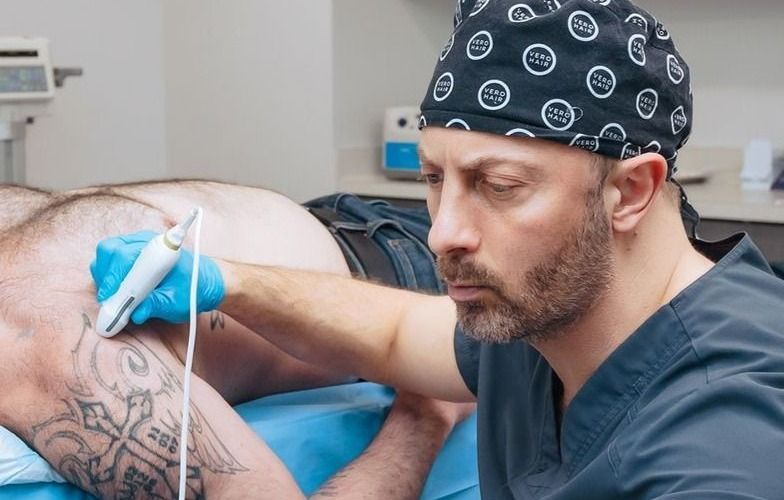
Every injection we do is placed by one of us, Dr. Locke or Dr. Berezovski, under live ultrasound or X-ray guidance, so it lands in the capsule and not just somewhere nearby. Which treatment we use depends on how far along your shoulder is.

PRP
For a lot of patients we start with platelet-rich plasma. It’s made from a small draw of your own blood, spun down so the platelets and their growth factors are concentrated. Those growth factors help settle inflammation and support healing.
A review published in 2026 pulled together 13 randomized trials, more than 1,000 patients in all, comparing PRP with cortisone for frozen shoulder. For the first one to three months the two were about even on pain. By six months, the PRP groups were doing clearly better on pain, function and range of motion. [2] That matches what we see in the office: cortisone tends to wear off, while PRP keeps working.
Stem cell therapy
When a shoulder is badly stiffened, or hasn’t responded to other treatment, we may move to stem cell therapy. Depending on the person, the cells come from your own bone marrow or fat, or from donor-screened umbilical cord and placental Wharton’s jelly tissue. Mesenchymal stem cells are strong regulators of inflammation, and inflammation is a big part of what drives a frozen shoulder.
Stem cell exosomes
Exosomes are tiny packets that stem cells release to talk to the cells around them. They carry signals that calm inflammation and, as you’ll see in the next section, signals that tell scar-forming cells to stand down.
All of this is done right in the office. You go home the same day and start gentle stretching, which is a lot easier once the pain has quieted down.
Can it be stopped before it starts?
This is the part of the research we find most exciting. Frozen shoulder begins as inflammation and only later turns into scar tissue. So researchers have started asking a simple question: if you treat the shoulder early, or treat a high-risk shoulder before it ever stiffens, can you keep it from freezing at all?
A team in Switzerland tested exactly that with PRP. They used an animal model where the shoulder is injured and then held still, a lot like an arm sitting in a sling after an injury or surgery. Shoulders that got a single PRP injection at the time of the injury didn’t develop the marked changes in the joint lining that showed up in the untreated shoulders, and there were no side effects. The authors described PRP as a potential way to prevent frozen shoulder. [3]
A 2022 study in Bioactive Materials looked at exosomes from human bone marrow stem cells. In the lab, they turned down the scar-forming signals in shoulder capsule cells and cut collagen buildup. In mice with stiff shoulders, they reduced scarring in the capsule and the shoulders moved better. The researchers even tracked down the specific anti-scarring signal the exosomes were carrying. [4]
To be fair, the prevention work is still mostly in the lab and in animals. But it lines up with the human trials, where PRP’s edge over cortisone grows with time [2] , and it lines up with what we see day to day. The earlier we treat an inflamed, stiffening shoulder, the better it tends to do.
So if you have diabetes or a thyroid condition, if you’re just coming out of a sling, or if you’ve already been through frozen shoulder on the other side, give us a call as soon as that shoulder starts to ache and tighten. Catching it in the freezing phase may save you a year or more of stiffness.
What a visit with us looks like
It starts with a free phone consultation. One of our Care Coordinators will call you back within 2 hours during business hours.
From there you’ll see one of us in person. We’ll examine the shoulder, go over any X-rays or MRI you have, figure out which phase you’re in, and look for anything else that could be part of the picture, like a rotator cuff tear or arthritis. Then we’ll tell you what we recommend and what it costs, before you commit to anything.
The procedure itself is a single office visit with image-guided injections and no hospital stay. Afterward we’ll send you home with a stretching plan and see you back to check on your progress.
The bottom line
Frozen shoulder can take a year or more out of your life if you just wait for it to thaw. You don’t have to sit through that. PRP, stem cell therapy and stem cell exosomes go after the inflammation and scarring behind it, can help you get moving sooner, and may keep a high-risk shoulder from freezing in the first place.
If your shoulder is getting tighter by the week, and especially if you have diabetes or you’re recovering from a shoulder injury or surgery, request a free phone consultation. We’ll give you a straight answer about whether regenerative treatment makes sense for you.
References
- Chen MH, Chen WS. A Narrative Review of Adhesive Capsulitis with Diabetes. Journal of Clinical Medicine. 2024;13(19):5696. Link
- Xu C, Wang Z, Tan J, et al. Comparison of the efficacy of platelet-rich plasma versus corticosteroid in the treatment of adhesive capsulitis: a systematic review and meta-analysis based on randomized controlled trials. Frontiers in Medicine. 2026. Link
- Feusi O, Karol A, Fleischmann T, et al. Platelet-rich plasma as a potential prophylactic measure against frozen shoulder in an in vivo shoulder contracture model. Archives of Orthopaedic and Trauma Surgery. 2020. Link
- Luo Z, Sun Y, Qi B, et al. Human bone marrow mesenchymal stem cell-derived extracellular vesicles inhibit shoulder stiffness via let-7a/Tgfbr1 axis. Bioactive Materials. 2022;17:344–359. Link
Written by our physicians
Every procedure at Spectrum is performed by a physician — Dr. Roman Berezovski and Dr. Alan Locke work side by side, using live ultrasound or X-ray guidance to place treatment exactly where you hurt.


Keep reading
PRP vs. stem cells for shoulder pain: which is right for you?
How PRP and stem cell therapy differ, who each one is for, and what to expect at our Wauwatosa clinic.
Read more →
Shoulder pain? Your treatment options for rotator cuff tears
Why surgery has high re-tear rates, and how bone marrow stem cell and PRP injections offer a non-surgical option.
Read more →
What is platelet-rich plasma (PRP) therapy?
How this natural, non-surgical treatment uses your own platelets to promote healing and recovery.
Read more →Ready to get back to the life you love?
Start with a free phone consultation with a doctor. We’ll review your symptoms and imaging and tell you honestly whether you’re a candidate.
